The Power of Notation
What the guitar music notation debate teaches us about notation in general.
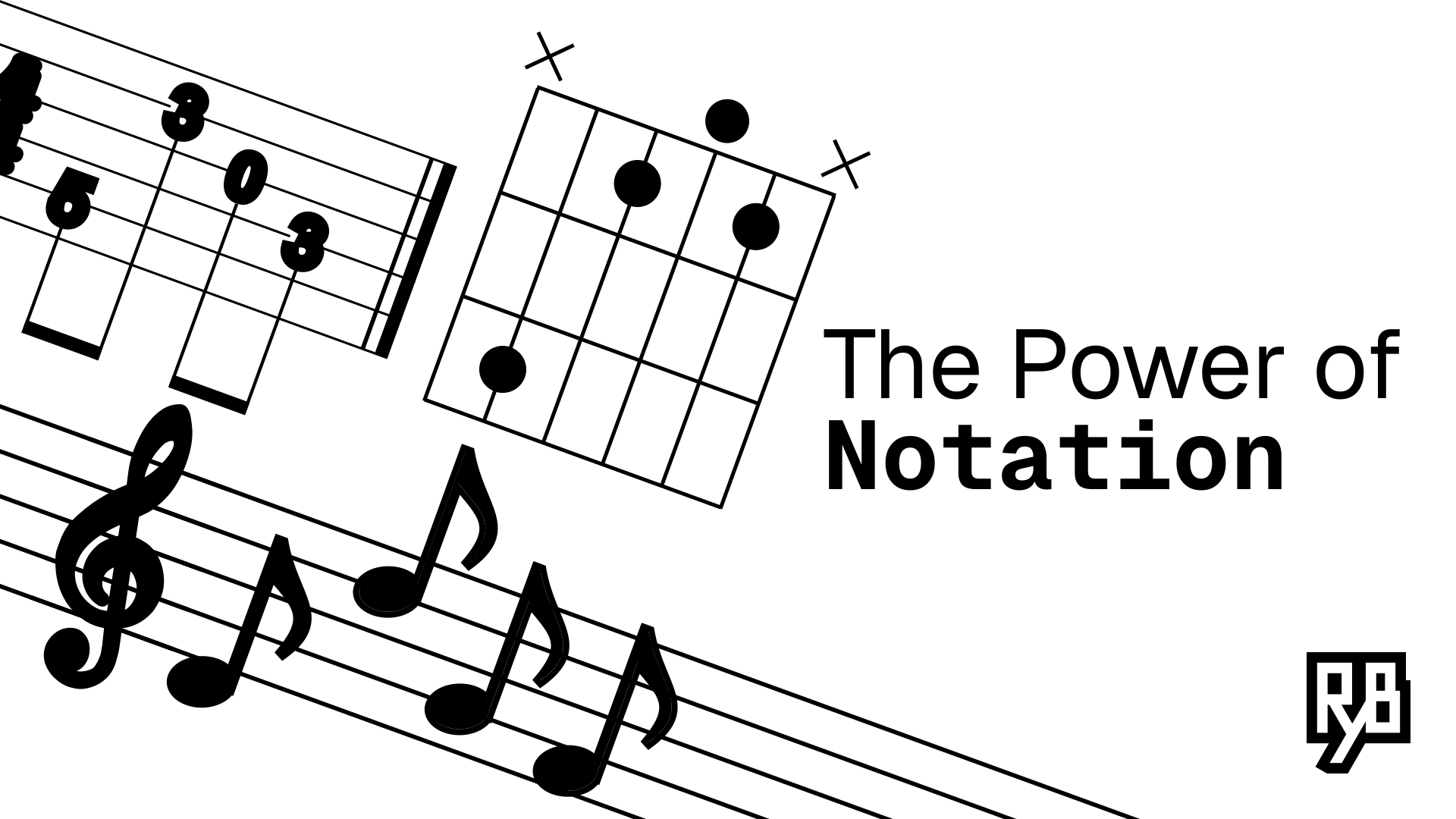
What is musical notation?
There are all sorts of musical notation. Many people are perhaps familiar with Western musical notation:
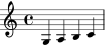
In scientific pitch notation, the above denotes playing notes G4, A4, B4, and C5 for one beat each. In solfège, this would be sol, la, ti, do for one beat each. Regardless of what notation you use, notation essentially boils down to what is played when.
What is tablature?
For those who play fretted instruments such as the guitar, an alternative notation called tablature (or tab for short) may also be familiar:
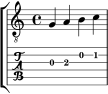
In tabs, frets of a stringed instrument are used to denote what notes are played. Here a guitar, tuned to E3 A3 D4 G4 B4 E5 from bottom to top, is used as reference. For example, B4 corresponds to fret 0 (i.e. the open, unfretted string) of the string B4. C4 corresponds to fret 1 of the same string, because it’s the next note up in 12 equal temperament.
One of the major advantages of tabs is that it shows not only what notes to play, but also where to play them. For example, consider this alternative fingering:
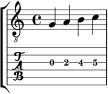
Here, the same four notes are played on the G4 string, and the B4 string is unused. Without adding to the western notation, we are unable to differentiate between the two examples. After all, they play the same notes, just in different ways. This disambiguation of where to play notes is for me tabs’ biggest advantage compared to western notation.
The problem with tabs
Though tabs tell you where to play notes, it doesn’t tell you when to play them. Kind of. Consider this:
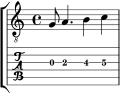
Here, G4 needs to be played for half a beat, while A4 needs to be played for one and a half beats. The western notation makes this precisely clear. The tabs just move the notes around so that the space between 0 and 2 is roughly half the space between 2 and 4. This can get very ambiguous very quickly. For example, here is the opening bar of Felicidade arr. Dyens:
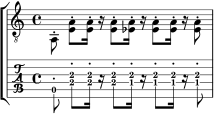
This creates a sort of tradeoff; you want the western notation for its precision in time, but you also want tablature for its precision in space (that is, where on the fretboard).
Just stave the tabs, right?
One solution to this conundrum is to just stave the tabs:
Personally, I think this is quite the elegant solution. However, it’s really not as simple as it seems.
The real problem with tabs
The staved tab above is an SVG engraved by LilyPond. Despite the existence of such tools, most people are still exposed to tabs in raw text form:
|----------------------|-----------------------||----------------------|-----------------------||---2-2--2-2--2-2--2-2-|--2-2--2-2--2-2--2-----||---2-2--2-1--1-1--1-2-|--2-2--2-1--1-1--1-----||-0--------------------|-----------------3p2---||----------------------|---------------------0-|Many sites like Classtab, Acousterr, and much of Ultimate Guitar present sheet music exclusively through this text tab format. Some sites, namely Songsterr, have implemented far more feature-rich, modern formatting, but started off as raw text too.
I’m not quite sure why this is the case, and my simple searches haven’t found much discussion on why either. My guess is a combination of early internet, the ease of writing and storing text, and the fact that most guitar players only really care about chords and don’t really need any more from their notation.
The elephant in the room
“Most guitar players only really care about chords and don’t really need any more from their notation.” Is this even true?
I’m not sure how to answer this question, or if there even is an answer to begin with. I can at least discuss some personal experiences I’ve had with the matter:
-
One time, a friend was shocked to see I played sheet music with tabs and single, plucked notes. He was of the conception that guitarists just “strum chords” and didn’t play single notes like pianists or violinists.
-
Another time, a more experienced player than myself expressed disdain for tabs, because of how ambiguous they are with timing. Apparently they had never seen staved tab notation before. This is surprising, since staved tabs have been around for nearly century to my best understanding. They were immediately converted to tab-lovers upon this discovery.
-
Another friend stated that they had never learned standard western notation. All this time, they relied on recordings to interpret tab timings.
These experiences tell me that preference for notation is as much about context and availability as it is about the characteristics of the notation itself.
Towards a solution?
On the other hand, many classical guitar transcribers actively advocate against the inclusion of tabs. Some of their arguments goes as follows:
Remark (An argument against tabs)
Consider this passage:
The tab can deceive the player into thinking they are playing on beat. In particular, here the rests between some notes may make it seem like the timing is not constant, despite the existance of beams. Furthermore, there is so much ink on the page the player may forget the staccato marks. The western notation forces players to slow down and consider fingerings that best suit them.
I think that there is a lot that can be learned from such arguments. At the same time, I think such arguments make underlying assumptions that not all players may agree with.
The solution is choice, right?
It’s very tempting to conclude that choice is the solution. Just give both. Those who prefer one and dislike the other can just pretend the other does not exist.
This is great in theory, but difficult in practice. A lot of this difficulty comes from translating between one notation and the other. Given western notation, there’s a lot of choice involved in what strings and fingerings should be chosen to play them. Conversely, given (unstaved) tabs, there’s a lot of freedom on how to time and accent the notes. (This all assumes there is no reference recording. But even if there is, best of luck transcribing it into either notation!)
This is even worse if all you have is a pdf of the western notation or a text-based representation of the tab. A lot of manual work is necessary to make the conversion. A lot of AI tools exist out there that do this, but beyond identifying chords and overall melody, I don’t see them getting very good anytime soon (I would not mind if they do though…).
The power of notation
Personally, I would often stop learning a piece simply because either the western notation or tab was not available. I think this is especially true for more technically intricate pieces, where either notation struggles to give a full picture of what should be played.
In such cases though, I don’t think its fair to blame any notation. At the end of the day, notation is just a means to share music in a more accessible way. Rather than having to listen to a recording over and over again, a score presents a concise, searchable way to learn the piece.
Sometimes, there are pieces that you need to listen to to really get. Other times, there are pieces that look and sound completely impenetrable but become significantly easier with a score. At that point, I don’t think it really matters whether the score is a tab or a stave. What matters is how much work and details were put into its construction.
Conclusions, and why this post exists
I’ve always wanted to write this post to cope, in my own way, with the many, low quality scores of either notation (I’m looking at you, text-based tab websites…). Writing this, I realize this is not the issue. I just want someone to make high quality scores of the pieces I want to learn, regardless of notation!